Airplane Outline Vector Illustration: Precision and Flexibility for Modern Design
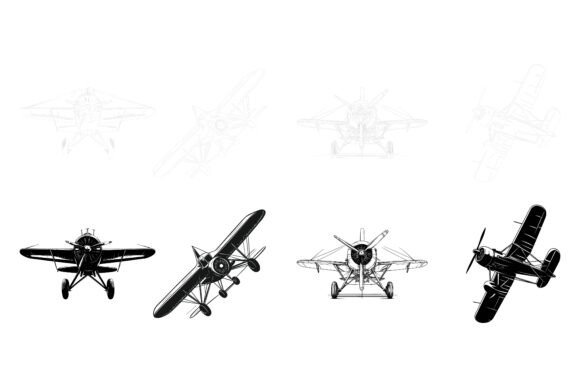
In the world of digital design, clarity and adaptability are paramount. An airplane outline vector illustration represents more than just a graphic of an aircraft; it is a foundational design asset built for precision and reuse. At its core, this type of illustration is a scalable, mathematically defined image created in software like Adobe Illustrator, where paths, points, and curves define the form rather than fixed pixels. This means an airplane outline can be enlarged to billboard size or reduced to a tiny app icon without any loss of quality or detail.
The Design Challenge: Seeking Consistency and Efficiency
Designers, marketers, and content creators frequently face a common set of challenges. Projects require a cohesive visual language, often needing a recurring symbol like an airplane to denote travel, transportation, logistics, or global connectivity. However, sourcing or creating a suitable icon each time can lead to inconsistency in style, wasted time on repetitive tasks, and frustration when a raster image pixelates at the required scale. The goal is to find a resource that is not only high-quality but also inherently flexible, saving precious hours and ensuring professional results across multiple mediums.
How a Specialized Vector Set Addresses Core Needs
A specialized collection, such as a set offering an airplane outline vector illustration in AI and EPS formats, directly solves these problems. The vector nature guarantees the "perfection in details and consistency" mentioned, as the clean outlines remain sharp under any transformation. But the true help comes from the package's thoughtful construction. Being "designed for Mac and Windows users" with a "neatly organized file and layer structure" removes technical barriers. You aren't wrestling with a confusing, flattened graphic; you're accessing a logical, editable asset where elements like the fuselage, wings, and tail might be on separate layers, allowing for easy modification.
Practical Applications and Real-World Outcomes
The suitability "for print, web, symbols, apps, infographics" opens a vast landscape of use cases. Consider a travel agency: they can use the same airplane outline vector illustration on their website header, in a printed brochure, and as a pin icon on their mobile app, all with identical crispness. A logistics company might integrate it into complex infographics explaining their supply chain. An app developer could scale it down for a button within a flight booking interface. The outcome is a unified brand identity and a significantly streamlined workflow. Instead of creating or buying new assets for each platform, one master file serves all purposes.
Empowering Customization: Edit, Color, and Modify
The phrase "you can edit it, change colors and modify the icon so easily according to your needs" is the key to user empowerment. Perhaps the default outline is perfect, but you need it in your brand's teal color. A simple fill change in Illustrator accomplishes this instantly. Maybe you need the airplane to appear in a silhouette style or combined with other vector elements like a globe or a route line. Because the illustration is vector-based, these modifications are straightforward, not destructive. This adaptability means the asset evolves with your project, becoming a template for countless variations rather than a single-use graphic.
Tailored Approaches for Different Users
How different professionals approach this asset varies with their expertise and immediate goals.
For the seasoned graphic designer, the airplane outline vector illustration is a starting block. They appreciate the clean, organized layers as it allows them to deconstruct and rebuild, perhaps integrating it into a much larger, custom illustration for a client's annual report. Their focus is on leveraging the technical perfection to accelerate their creative process.
For the marketing professional with basic design software skills, the asset is a reliable, ready-to-use solution. They might primarily use it to quickly produce consistent social media graphics, presentation slides, or PDF handouts. The ability to easily change colors means they can match company campaign themes without needing deep design knowledge.
For the small business owner or startup founder, such a collection is a cost-effective resource. It provides a professional-grade visual element that can be used across their nascent branding materials—from a website built on a template to simple flyers. It prevents the need to hire a designer for a single icon, offering immense utility and value.
Recommendations and Useful Considerations
When selecting a vector illustration set, consider the scope of your projects. An airplane outline vector illustration is a specific asset, so ensure it matches the style you require—is it minimalist, detailed, modern, or classic? Verify the file formats. The inclusion of AI and EPS ensures compatibility with professional vector software, while the JPG provides a quick reference or use in simpler applications. Always check the license terms to confirm your usage rights for commercial projects.
In practice, once you have the file, spend a few minutes exploring its layer structure. Understanding how it's built will make future edits faster. Create a palette of your brand colors and save them in your design software, so recoloring the airplane outline becomes a one-click task. If you anticipate frequent use, consider creating a few preset variations—a colored version, a silhouette, an outline with a shadow—and save them as separate files for even quicker access.
The Path to Implementation
Ultimately, an asset like this airplane outline vector illustration shifts your focus from asset creation to asset application. It solves the fundamental problems of scalability, consistency, and time. By providing a meticulously crafted, editable foundation, it empowers you to produce high-quality visual content that aligns perfectly across print and digital touchpoints. It turns a generic need for a travel icon into a specific, powerful, and flexible component of your visual toolkit. The utility lies not just in the graphic itself, but in the time, cohesion, and professional results it enables you to achieve. With such a resource in hand, you are equipped to communicate ideas clearly and effectively, letting your content take flight.