The Modern Workspace: Defining the Wood Desk with Computer Illustration Set
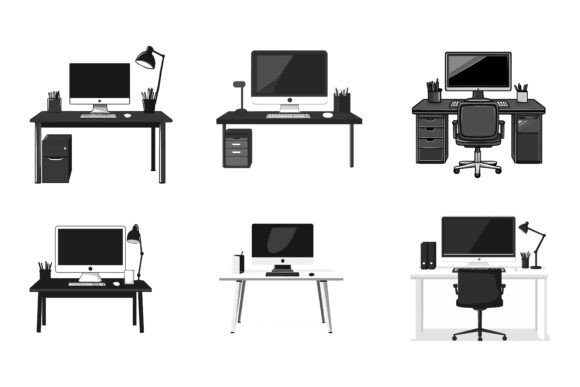
In digital design, the choice of illustration assets can significantly influence the tone and efficiency of a project. A collection like the Wood Desk with Computer illustration set represents more than just a series of images; it encapsulates a specific, contemporary aesthetic and offers a functional toolkit for creators. At its core, this set depicts the archetypal modern professional environment—a clean, wooden desk holding a computer, often accompanied by complementary office or study elements. Its distinction lies not merely in its subject matter but in its execution and the practical utility embedded within its file structure.
Evaluating the Core Attributes: What Sets This EPS Collection Apart
When considering illustration resources, professionals look beyond the surface imagery. The value is often locked in the technical delivery and adaptability of the files. This particular set, promoted as an AI EPS collection, highlights several attributes that merit comparison against general illustration resources. The provision of files in both AI EPS and JPG formats is a foundational decision factor. EPS files are vector-based, meaning they are built from mathematical paths rather than pixels. This allows for infinite scaling without any loss of quality, a critical feature for projects that may span from mobile app icons to large-scale print brochures. The JPG companion files offer a readily usable, rasterized version for quicker placement or environments where vector editing is not required.
A noteworthy strength is the emphasized file and layer structure. Many downloadable illustrations arrive as flattened, messy files with dozens of unnamed layers or grouped objects. A neatly organized structure, as claimed for this Wood Desk with Computer set, saves considerable time. It allows a designer to isolate specific elements—like the computer screen, the desk surface, or a nearby cup—for individual editing or reuse in other compositions. This organizational discipline directly impacts workflow efficiency.
Perfection in Details and Consistency: A Practical Advantage
The promise of "perfection in details and consistency" speaks to a common pain point in using assembled illustration sets. Often, collections sourced from multiple artists or compiled over time suffer from inconsistent line weights, shading styles, or color palettes across different icons. A cohesive set, where every element of the Wood Desk with Computer scene shares the same visual language, ensures that the final design output looks polished and professional. This consistency reduces the need for manual tweaking to make elements harmonize, which is particularly beneficial for infographics or multi-page documents where repeated visual motifs are used.
Comparing Formats and Applications: Vector Versus Raster
Understanding the tradeoffs between different illustration formats is key to making an informed resource choice. The dominant alternative to vector EPS files is raster imagery (like PNG or high-resolution JPG). Raster images are excellent for complex textures and photorealistic details but have fixed resolutions. Enlarging them leads to blurriness. The Wood Desk with Computer set, by offering the core artwork as a vector file, positions itself for versatility. It is inherently "suitable for print, web, symbols, apps, infographics" as stated, because the same master file can output at any size needed.
However, a vector-based approach has its own considerations. Highly detailed, artistic illustrations with nuanced textures might be harder to render perfectly in vector form. This set, focusing on a clean, likely stylized depiction of a desk and computer, seems tailored to a more graphic, perhaps minimalist aesthetic. For projects requiring a hyper-realistic, textured wood grain or a detailed computer keyboard with individual keys, a high-quality raster photograph or a specialized raster illustration might be a better fit. The choice here hinges on the desired style and the required scalability.
Editability as a Decision Factor: When Flexibility Matters Most
The ease of editing, changing colors, and modifying icons is a significant benefit highlighted for this collection. This is a direct function of the vector format and the organized layer structure. In practice, this means a designer can alter the wood finish from light oak to dark walnut, change the computer's color from silver to black, or remove elements to create a simpler scene without needing to redraw anything. This level of control is ideal for branding projects where specific corporate colors must be matched, or for iterative design where the illustration needs to adapt across multiple campaign variants.
Comparatively, using a pre-made raster image (JPG or PNG) of a wood desk with computer offers far less flexibility. Color changes require more complex masking and recoloring work, and isolating elements is difficult. Purchasing a set that includes the editable source file (like the AI EPS file here) is often the preferred route for designers who anticipate the need for customization. It's a tradeoff between initial convenience and long-term adaptability.
Identifying the Best-Fit Situations and Potential Limitations
When might this Wood Desk with Computer AI EPS collection be the right choice? It aligns strongly with projects that demand a scalable, clean, and customizable representation of a modern workspace. Think of a tech company's website needing icons for its "Our Tools" section, a university's online learning portal illustrating the "virtual classroom," or a corporate report's infographic about remote work trends. The set's suitability for symbols and apps makes it relevant for UI/UX designers needing a cohesive set of interface icons depicting office activities.
Its limitations may surface in projects requiring a different artistic tone. If the desired aesthetic is hand-drawn sketch, gritty realism, or highly detailed 3D render, this specific vector set might not integrate well. Furthermore, while it includes a JPG, the primary power is in the editable EPS. For a user without access to or skills in vector editing software (like Adobe Illustrator), the practical utility diminishes. The mention that it's "designed for Mac and Windows users" suggests compatibility with standard design software, but the user still needs the appropriate application to harness the full value.
Balancing Needs: When to Seek Alternatives
A practical comparison involves weighing project requirements against resource offerings. If a project's scope is a single, fixed-size web banner where a stock photo of a desk will suffice, investing in a specialized vector illustration set might be unnecessary. Conversely, for a long-term, multi-format project like designing an entire suite of marketing materials for a co-working space company, where the desk and computer icon needs to appear in dozens of sizes and color schemes, a well-structured, editable set becomes a strategic asset.
Alternatives to such a curated set include sourcing individual vector icons from larger, more general libraries, commissioning a custom illustration, or using free vector resources. The tradeoffs here involve time, cost, and consistency. General libraries may offer a desk and a computer separately, but they might not share the same style, requiring work to make them cohesive. Custom illustration offers perfect fit but at a higher cost and time investment. Free resources may lack the organizational polish or commercial license security. This Wood Desk with Computer set occupies a middle ground: offering a cohesive, ready-made scene with professional editing capacity at a likely point cost.
Making a more informed decision ultimately rests on auditing your specific project's needs. Consider the output mediums (print, web, app), the required scale variations, the need for brand color alignment, and the design team's software proficiency. An illustration set like this one solves for scalability, consistency, and editability. It may not solve for ultra-specific artistic styles or for users confined to raster-only editing workflows. By focusing on these practical dimensions—file format, structure, and application scope—rather than promotional hype, you can better evaluate if such a resource aligns with your current design objectives.