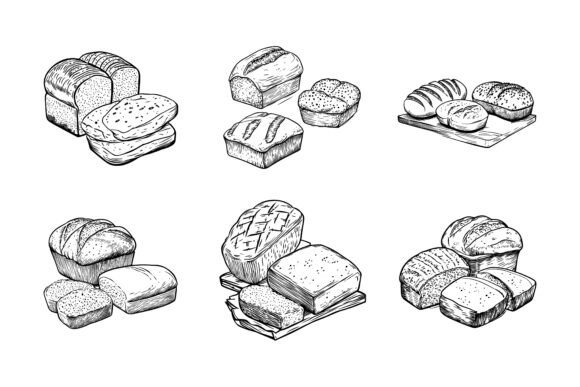
Understanding Bread Vector Hand Drawn Illustration: Distinct Style and Practical Applications
In the digital design landscape, where crisp, geometric vectors dominate, a Bread Vector Hand Drawn Illustration offers a distinct alternative. This style combines the scalable, editable nature of vector graphics with the warmth and organic feel of hand-drawn art. Unlike rigid, computer-generated icons, these illustrations mimic the imperfections and personality of sketching with pen or pencil, but are crafted within vector software. This fusion results in an asset that is both versatile for professional projects and visually approachable.
The Defining Characteristics of Hand Drawn Vector Art
What makes this category distinct is its intentional departure from precision. While standard vector illustrations rely on perfect curves and mathematically defined shapes, hand drawn vector styles, including Bread Vector Hand Drawn Illustration, embrace subtle irregularities. Line weights may vary, outlines might appear slightly textured, and shapes can have a charming, "off-the-page" quality. This aesthetic is not a result of technical limitation but a deliberate artistic choice, often achieved by using specialized brushes or painstakingly tracing actual sketches.
The core value lies in its emotional resonance. A simple icon of a loaf of bread created with flawless vectors communicates "bread" efficiently. The same icon, rendered as a Bread Vector Hand Drawn Illustration, can also convey concepts like "homemade," "artisan," "organic," or "nostalgic." It adds a layer of narrative and human touch that purely technical graphics often lack.
Comparing Illustration Styles: Where Hand Drawn Vectors Fit
When evaluating assets for a project, designers typically consider several stylistic paths. Photorealistic vectors offer detail and accuracy, flat design provides clarity and modern minimalism, and 3D rendered graphics deliver depth and realism. The Bread Vector Hand Drawn Illustration occupies a different niche, prioritizing authenticity and softness over sharpness or literal detail.
A key tradeoff is scalability versus aesthetic consistency. Both a flat vector and a hand drawn vector are infinitely scalable without loss of quality. However, the hand drawn style may not be suitable for contexts demanding absolute uniformity and corporate polish, such as complex technical diagrams or formal financial reports. Its strengths shine in projects where building an emotional connection is paramount: branding for bakeries, cafes, or food blogs, educational materials for children, lifestyle app interfaces, or packaging for artisan products.
Evaluating File Formats and Usability: The AI EPS Collection
The practical utility of an illustration set is heavily dependent on its file format and internal organization. An offer for a collection that includes Bread Vector Hand Drawn Illustration in AI and EPS formats, alongside a JPG preview, speaks to professional usability. The AI (Adobe Illustrator) and EPS (Encapsulated PostScript) files are native vector formats, meaning the artwork is composed of editable paths, not fixed pixels.
This is a significant advantage over purchasing only raster images (like PNG or JPG). With vector files, you can resize the illustration from a tiny app icon to a large poster without any blurring or pixelation. You can also dissect the artwork. If the Bread Vector Hand Drawn Illustration of a bread loaf includes a sketched crumb detail, you can potentially isolate and reuse that element. The promise of a neatly organized file and layer structure further enhances this editability, saving hours of time for designers who need to adapt assets to specific color schemes or compositional needs.
Key Decision Factors for Potential Users
Deciding whether a Bread Vector Hand Drawn Illustration set is the right resource involves weighing several factors.
- Project Tone: Is the goal to appear friendly, creative, and personal? Hand drawn vectors are often a better fit than stark, minimalist icons.
- Production Requirements: Do you need to print the artwork at various sizes, or use it across web and mobile platforms? The vector format (AI/EPS) is essential here.
- Team Skill Level: Are you or your team comfortable using vector editing software like Adobe Illustrator? While the files are editable, they require such software to modify.
- Style Consistency: Can you source a full set of illustrations in this consistent style for your entire project? Using one hand drawn bread icon amidst a suite of flat icons can create visual discord.
For users on Mac or Windows who regularly work within professional design ecosystems, the compatibility mentioned is straightforward. For those who primarily use basic image editors or online tools without vector support, the JPG file might be the only usable component, which forfeits the core benefits of scalability and editing.
Practical Applications and Realistic Use Cases
The listed suitability for print, web, symbols, apps, and infographics covers broad territory. Let’s consider concrete scenarios. A small bakery developing its identity might use a Bread Vector Hand Drawn Illustration as the central logo, ensuring it looks equally good on a small business card and a large storefront sign. A food blogger could integrate such illustrations into their website header and throughout recipe posts to establish a consistent, welcoming visual theme.
In the context of an app, these illustrations could serve as onboarding graphics or category icons within a recipe organizer, providing a softer, more engaging user experience compared to standard glyph icons. For infographics about nutritional topics or agricultural processes, hand drawn elements can make dense information feel more accessible and less clinical.
A limitation to consider is specificity. A generic hand drawn bread illustration is wonderfully versatile, but a project requiring a very specific type of bread—say, a distinct regional sourdough with particular scoring patterns—might need custom illustration work. Pre-made collections offer efficiency and cost savings, but may not cover every niche requirement.
When to Choose This Style and When to Look Elsewhere
The Bread Vector Hand Drawn Illustration, particularly in a well-structured AI EPS collection, is a strong candidate for projects that balance professional utility with a desire for human-centric design. It is an excellent choice for entrepreneurs, marketers, and designers in the food, lifestyle, education, and craft sectors who need scalable, editable artwork that conveys warmth.
You might need another option if your project demands ultra-modern, abstract aesthetics (where flat design prevails), or requires hyper-realistic imagery (where photography or 3D modeling is better). Similarly, if your workflow does not involve vector editing software and you only need a fixed-size image for a single use, the investment in a vector collection may not offer its full value to you.
The ability to easily edit colors and modify icons is a powerful feature, allowing the asset to adapt to different brand palettes or to be broken down into component parts. This positions it as a flexible resource, not a static commodity. For the user comparing options, the decision ultimately hinges on aligning the asset's stylistic expression with the project's emotional goals and its technical format with the production realities.
Making an Informed Decision on Digital Assets
Selecting design resources is rarely about finding the single "best" option; it's about finding the best fit. A Bread Vector Hand Drawn Illustration set represents a specific intersection of art style and file functionality. By understanding that its hand drawn nature evokes a particular tone, and that its AI/EPS format provides a particular level of professional control, you can evaluate it against your actual needs.
Consider the longevity of the asset. A vector file you can edit and repurpose for future projects offers ongoing value. Compare this with the one-time utility of a raster image. Also, assess the coherence of the entire collection. Is the hand drawn style consistent across all included icons? Does it complement other visual elements you already use?
Ultimately, resources like this fill a clear gap in the market, catering to users who want the scalability and editability of vectors without the coldness that sometimes accompanies them. By focusing on the practical aspects—the project context, the required output, and your technical capabilities—you can determine whether this specialized illustration approach is the right tool for your current creative task.